Kōbō Daishi and the World That Speaks
Serpent Painting Journal · Essay 01
Gate Gate Para Gate Para Sam Gate Bodhi Soha
Gone, gone, gone beyond, gone completely beyond. Awakening! So be it.
Heart Sūtra
Kūkai, the founder of Shingon Buddhism, made a radical claim: the world itself speaks the Dharma. His life brings that claim into conversation with Zen practice, the kami of Mount Kōya, and the work of the brush.
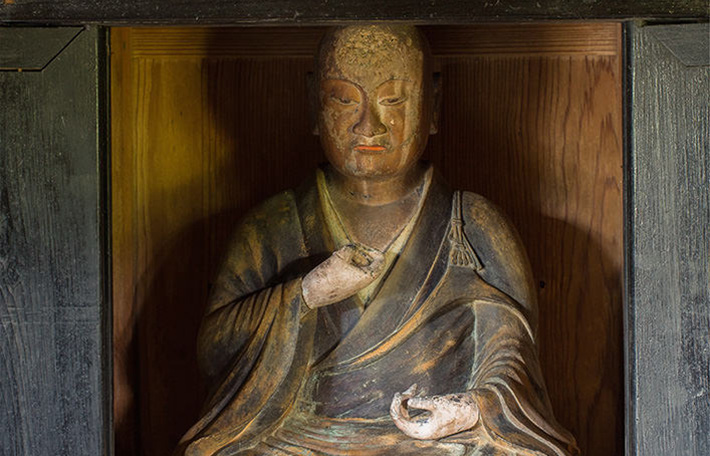
After returning from China, Kūkai looked for a place to establish a monastery. In the founding legend told by Kongōbuji, he meets a hunter with two dogs, one black and one white. The hunter is Kariba Myōjin, a local deity in human form. The dogs guide Kūkai toward Mount Kōya, where he meets Niu Myōjin, the goddess of the mountain. She welcomes him and offers him land for the monastery. Kūkai honors both deities as guardians of the mountain. In this telling, the Buddhist monastery begins with the welcome of the deities already honored there.
From Shikoku to Chang’an
Kūkai (774–835), later honored as Kōbō Daishi, was born into a regional aristocratic family on Shikoku. He studied the Chinese classics in preparation for government service, then turned toward Buddhist practice and mountain austerities. In 804 he sailed to Tang China with a Japanese mission. At Qinglong Monastery in Chang’an he received initiation from the esoteric master Huiguo. He returned to Japan in 806 carrying texts, ritual implements, and images. These materials helped him teach the rituals he had learned in China. A painted mandala, for example, shows where each buddha or bodhisattva appears in the space the practitioner is learning to picture in meditation. That visualization can be combined with reciting a mantra and making ritual hand gestures, called a mudrā. Kongōbuji’s account of Kūkai’s life traces the journey.
In 816 Kūkai established a community for practice on Mount Kōya. In 823 Emperor Saga entrusted him with Tōji, a state temple in Kyoto. The mountain and the capital were both part of his work. At one he built a retreat center; at the other he gave esoteric Buddhism a public institutional home. He was also a calligrapher, a fact that takes on particular weight in light of his thinking about the life of signs. Tōji’s temple history recounts his role there. He was the originator of the Single Stroke Serpent painting that I practice.
What a body can know
Shingon means “true word.” In The Meanings of Sound, Sign, and Reality, Kūkai argues that the Dharma body teaches through the forms and sounds of the cosmos. A mantra gives the practitioner a way to participate in this speaking world. A mandala gives the eye a way to enter it.
In The Meaning of Becoming a Buddha in This Very Body, the question is examined how this participation becomes wisdom. The practitioner makes a gesture, recites a mantra, and visualizes and thus becomes the deity. Body, speech, and mind are called the “three mysteries,” and together they enact a correspondence with the activity of Mahāvairocana, the cosmic Buddha. The phrase “this very body” forces us to understand that our body, speech, and mind are already that of Buddha Nature. The breath and the hands with which one goes about ordinary life are also the means of realization. Both treatises are available in the BDK translation of Shingon Texts.
A secret key to the Heart Sūtra
In Secret Key to the Heart Sūtra, Kūkai asks what exoteric Sutras reveal when read as an esoteric teaching. As Thomas Eijō Dreitlein explains in his annotated translation, Kūkai reads the sūtra as a dharma maṇḍala that gives verbal form to the meditative realization of the bodhisattva deity Prajñā. Even the syllables of the closing mantra can unfold into teachings. Kūkai compares the skilled reader to a physician who recognizes medicines in plants a passerby might take for weeds. The difference lies in the eye that has been trained to see. This reading gives us a way to think about why a sūtra might be chanted before painting: the words prepare an attention the hand transforming the practitioner into the deity who then imbibes the painting with wisdom intention and life force.
A conversation with Zen
If one chooses to read Kūkai beside Dōgen, who lived four centuries later, a kinship comes into view. In Genjōkōan, Dōgen describes studying the self until the self is forgotten and the myriad things arise. Both thinkers express what happens when the practitioner ceases to stand apart from the world as its spectator. The distinction matters as much as the affinity: Dōgen’s account of practice and realization belongs to Sōtō Zen; Kūkai’s way of entering the world’s teaching depends on esoteric initiation and the three mysteries. Taken together they form an interesting view of what is the Buddha Dharma and how to practice it.
The kami and the mountain
At Kōyasan’s Danjō Garan, the Miyashiro shrine still honors the mountain’s tutelary powers. Niu Myōjin and Kariba Myōjin belong to the local sacred geography in which Kūkai’s monastery took root. Calling this a Shinto dimension of practice is useful if we remember that the sharp institutional division between Buddhism and Shinto came much later in the thought of its practitioners. The founding story of Kūkai’s monastery makes the relationship clear: a Buddhist community owes something to the place that receives it. Hence it is upon us, as practitioners, to revere the spirits of the place and earth, and treat them as a sacred part of life.
Kūkai died in 835. In the devotional tradition of Okunoin, he entered meditation that continues to this day. That belief gives his biography an unusual ending. Life is temporary, but the work of attending to the suffering of beings continues through a bodhisattva’s intentions. Kongōbuji describes that devotion in its account of Okunoin.
Back to the brush
In Richard Daiensai Kirsten’s account of his teacher Kendo Kano, the dragon image carries Kōbō Daishi’s name. This is evidence of how the painters understood their inheritance comes from the ninth century calligraphy and teachings of Kūkai.] A brushstroke is a movement of the hand, flowing ink, cosmic breath, and a form is generated that the eye learns to follow. Kūkai asks us to take seriously the idea that a creative gesture and form can bring about the realization of Buddhahood. The serpent painter must reaveal truth, or dharma, every single time the brush touches the paper.
Further reading: Thomas Eijō Dreitlein, An Annotated Translation of Kūkai’s Secret Key to the Heart Sūtra (Kōyasan University, PDF).